

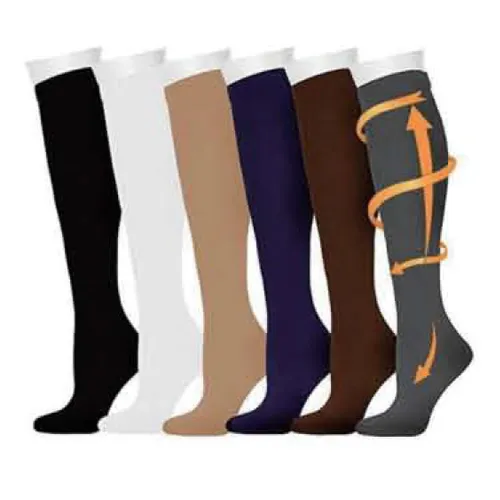
Private label and custom development describe different starting points for a branded compression sock program. Private label usually begins with an existing product direction that receives approved brand and presentation changes. Custom development begins with a more specific product brief and may require new work around construction, materials, sizing and sampling.
The choice depends on how much of the product is already defined, how much construction needs to change and which decisions the buyer is prepared to make during development.
What are private label compression socks?
Private label compression socks are products based on an established manufacturing direction and presented under the buyer’s brand. The available changes depend on the manufacturer and the product. They may include approved colors, branding and packaging, while the core construction remains closer to an existing basis.
This route can be appropriate when a brand values a defined product foundation more than a highly differentiated construction. It still requires proper sampling and approval. “Private label” should not be understood as permission to skip fit review, artwork confirmation, packaging control or documented product requirements.
What is custom compression sock development?
Custom development, often discussed within OEM / ODM work, starts from requirements specific to the buyer’s product. These can include construction direction, size system, materials, visual design, branding and packaging. The manufacturer develops samples that turn those requirements into a physical reference.
A custom project usually contains more connected decisions. Changing a yarn or structure can affect appearance, stretch, dimensions or finishing. That is why custom work benefits from an orderly sequence: brief, development, sample review, approved reference and production.
Custom does not mean every idea can be manufactured exactly as drawn. It means the development process is organized around the buyer’s defined product rather than around a presumed off-the-shelf item.
How do the two approaches differ in practice?
The main difference is the amount of product definition that changes before production. Private label generally keeps more of the product basis stable and concentrates work on approved brand-facing elements. Custom development opens more of the construction and specification to project-specific decisions.
| Decision point | Private Label | Custom Development |
|---|---|---|
| Starting point | Established product direction | Buyer-specific product brief |
| Construction changes | More limited | Broader project-specific development |
| Sampling scope | Focused | Usually broader |
| Branding flexibility | Brand and presentation focused | Can be integrated deeper into product development |
| Buyer input required | Lower | Higher |
Which route gives a brand more differentiation?
Custom development generally provides more room for a distinct product because more variables can be defined around the brief. Differentiation may come from fit direction, construction, material selection, branding integration, colors or packaging—not simply from adding a logo.
More differentiation also creates more decisions. A brand needs to identify which features genuinely matter to its customer and which changes add complexity without adding meaningful value. A focused custom brief is usually more productive than a long list of disconnected features.
Private label fits projects where an established product direction already meets the intended use and differentiation is concentrated in branding and presentation.
What should buyers ask a manufacturer?
Buyers should ask the manufacturer to define what is fixed, what can be changed and what must be sampled. If the same terminology is being used differently by each party, the project can become unclear very quickly. A written scope avoids relying on labels such as private label, OEM or ODM without a shared definition.
How can a brand choose the right development route?
Start with the product promise. If the brand needs a particular construction, material direction, size logic or integrated design, custom development is likely the more relevant discussion. If an established product basis meets the intended use and the main needs are branding and presentation, a private label route may be sufficient.
Then assess the information available. A custom project works best when the brand can make timely decisions and review samples against specific objectives. Where key decisions are still open, the first conversation should focus on feasibility and development priorities rather than an immediate production commitment.
FAQ
Practical questions
Is private label the same as buying a stock catalog product?
Not necessarily. Private label describes a route based on an established product direction, but availability and permitted changes still need to be confirmed with the manufacturer.
Does custom development always require a new product from zero?
No. It can begin with a reference, an existing specification or a partially developed concept, then focus on the variables that need project-specific work.
Which route requires more buyer input?
Custom development generally requires more detailed decisions about construction, sizing, materials and presentation. Private label begins from a more established product direction.
ABOUT ARKSOCKS
Zhejiang Ark Industry Co., Ltd.
Zhuji, Zhejiang, China
Manufacturing hosiery since 2003.